
Stainless steel 90 degree elbows are one of the most widely used fittings in industrial piping systems. Their primary function is to change the direction of the pipeline by 90 degrees, enabling the piping system to make a 90-degree turn at a specific location and thereby alter the flow direction of the fluid. Depending on manufacturing processes, connection methods, and structural design, stainless steel 90 degree elbows can be categorized into various types, including long-radius and short-radius elbows, butt weld elbows, socket weld elbows, and threaded elbows. Stainless steel elbows offer excellent strength, durability, and corrosion resistance, making them suitable for a wide range of industries including petroleum and natural gas, chemicals, power plants, and water treatment.
Manufacturing Process of Stainless Steel Elbow
Pushing Process
This is a commonly used process. First, the stainless steel tube blank is heated to the appropriate temperature, then a specialized pushing machine is used to shape the tube blank into a 90-degree elbow using a die. The pushing process has high production efficiency, enabling large-scale production, and produces elbows with high dimensional accuracy and good surface quality.
Stamping Process
For smaller stainless steel 90 degree elbows, the stamping process can be used. Stainless steel sheets are cut into the appropriate shape, placed into a stamping die, and then pressed into the rough shape of an elbow using a stamping machine. Subsequent welding and finishing processes are then performed. The stamping process is suitable for mass production of elbows with relatively simple shapes.
Welding Process
First, the stainless steel sheet is rolled into two 90 degree curved sections, which are then welded together to form a 90 degree elbow. The welding process can produce large-diameter elbows but requires high-quality welding techniques to ensure the strength and sealing of the welds.
Classification by Bending Radius
Long Radius (LR) 90° Elbow:
The radius of curvature (R) is 1.5 times the nominal pipe size (NPS) or outside diameter (D). (R = 1.5D). This provides a smoother turn, reducing friction, turbulence, and pressure drop. It’s generally preferred when space allows and flow efficiency is critical.
Short Radius (SR) 90° Elbow:
The radius of curvature (R) is equal to the nominal pipe size (NPS) or outside diameter (D). (R = 1.0D). This results in a sharper turn, increasing turbulence and pressure drop, but it is more compact and suitable for tight spaces where a smaller bend is necessary.
Classification by Material:
Based on the different grades of stainless steel used, stainless steel 90 degree elbows can be categorized into 304 stainless steel 90 degree elbows, 316 stainless steel 90 degree elbows, 321 stainless steel 90 degree elbows, etc. Elbows made from different materials exhibit variations in corrosion resistance, high-temperature resistance, and other properties, making them suitable for different operational environments. The following chemical composition and mechanical properties are provided as examples for 304 and 316.
Butt Weld Stainless Steel Elbow Chemical Composition
| CHEMICAL | LIMITS | C | Mn | P | S | Si | Ni | Cr | Mo |
| ASTM A403 WP304 | MIN | 8.0 | 18.0 | ||||||
| MAX | 0.08 | 2.00 | 0.045 | 0.030 | 1.00 | 11.0 | 20.0 | ||
| ASTM A403 WP304L | MIN | 8.00 | 18.00 | ||||||
| MAX | 0.03 | 2.00 | 0.05 | 0.03 | 1.00 | 12.00 | 20.00 | ||
| ASTM A403 WP316 | MIN | 10.0 | 16.0 | 2.00 | |||||
| MAX | 0.08 | 2.00 | 0.045 | 0.030 | 1.00 | 14.0 | 18.0 | 3.00 | |
| ASTM A403 WP316L | MIN | 10.00 | 16.00 | ||||||
| MAX | 0.03 | 2.00 | 0.05 | 0.03 | 1.00 | 14.00 | 18.00 |
Butt Weld Stainless Steel Elbow Mechanical Property
| MATERIAL | ASTM A403 WP304 | ASTM A403 WP304L | ASTM A403 WP316 | ASTM A403 WP316L |
| T.S (MPA) | 515 min | 485 min | 515 min | 485 min |
| Y.S (MPA) | 205 min | 170 min | 205 min | 170 min |
| EL % | 28 min | 28 min | 28 min | 28 min |
Socket Weld & Threaded Elbow Chemical Composition
| CHEMICAL | LIMITS | C | Mn | P | S | Si | Ni | Cr | Mo | N |
| ASTM A182 F304 | MIN | 8.0 | 18.0 | |||||||
| MAX | 0.08 | 2.00 | 0.045 | 0.030 | 1.00 | 11.0 | 20.0 | 0.10 | ||
| ASTM A182 F304L | MIN | 8.00 | 18.00 | |||||||
| MAX | 0.03 | 2.00 | 0.045 | 0.030 | 1.00 | 13.00 | 20.00 | 0.10 | ||
| ASTM A182 F316 | MIN | 10.0 | 16.0 | 2.00 | ||||||
| MAX | 0.08 | 2.00 | 0.045 | 0.030 | 1.00 | 14.0 | 18.0 | 3.00 | 0.10 | |
| ASTM A182 F316L | MIN | 10.00 | 16.0 | 2.00 | ||||||
| MAX | 0.03 | 2.00 | 0.045 | 0.030 | 1.00 | 15.00 | 18.0 | 3.00 | 0.10 |
Socket Weld & Threaded Elbow Mechanical Property
| MATERIAL | ASTM A182 F304 | ASTM A182 F304L | ASTM A182 F316 | ASTM A182 F316L |
| T.S (MPA) | 515 min | 485 min | 515 min | 485 min |
| Y.S (MPA) | 205 min | 170 min | 205 min | 170 min |
| EL % | 30 min | 30 min | 30 min | 30 min |
| R/A % | 50 min | 50 min | 50 min | 50 min |
Classification by Connection Type
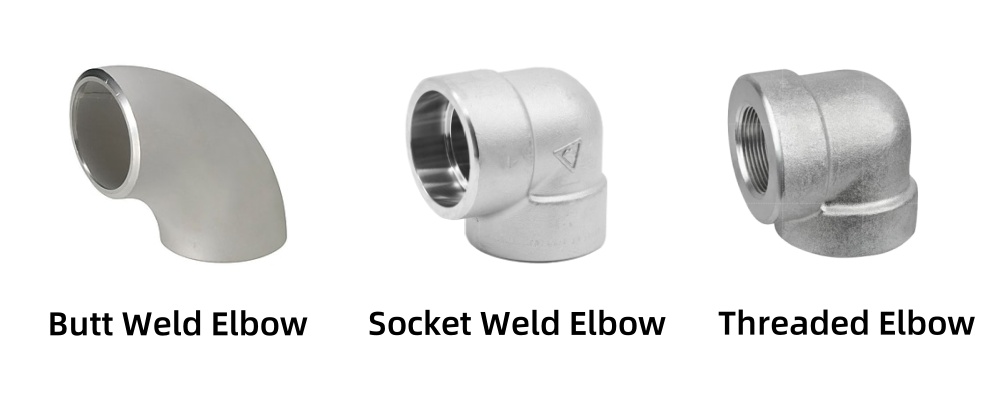
Butt Weld Elbow
Stainless steel 90-degree elbows are welded to tightly connect pipes, offering high strength and excellent sealing. They are the most common type in industrial piping systems. They can withstand high pressure and high temperature operating environments with virtually no leakage, making them particularly suitable for large-diameter, high-pressure, or high-temperature piping systems. However, this connection is not removable, requiring pipe cutting for repair or replacement.
Socket Weld Elbow
Socket-weld elbows are constructed by inserting the pipe into the socket of the elbow and then welding the elbow externally. They are commonly used for small-diameter, high-pressure pipes. They provide a secure connection, strong sealing, and are unlikely to leak, making them particularly suitable for high-pressure applications. Installation is relatively simple, making them particularly suitable for small-diameter pipes. However, the internal socket structure does introduce some fluid resistance.
Threaded Elbow
Threaded elbows connect pipes via threads, with both internal and external threads being common. They are primarily used for small-diameter, low-pressure pipes. They offer advantages such as easy installation and multiple disassembly capabilities, making them particularly suitable for pipe systems that require frequent disassembly or maintenance. However, the sealing performance is relatively weak and leakage is likely to occur under high pressure or vibration conditions, so it is not suitable for high temperature and high pressure environments.
Stainless Steel 90 Degree Elbow Applications
1. Oil and Gas Industry: Used for transporting crude oil, natural gas, and in refinery pipeline systems, suitable for high-temperature and high-pressure environments.
2. Chemical Industry: Suitable for conveying corrosive media such as acids, alkalis, and salts in pipeline systems.
3. Power Industry: Commonly used in boilers, cooling water pipelines, and high-pressure steam systems.
4. Water Treatment and Supply Systems: Suitable for potable water, wastewater, and industrial water pipelines, ensuring long-term corrosion resistance.
5. Pharmaceutical and Food Processing: Ensures pipeline hygiene, corrosion resistance, and suitability for conveying pure fluids.
6. Marine Engineering: Used in ship and offshore platform pipeline systems, resistant to salt fog and seawater corrosion.
7. Air Conditioning and HVAC Engineering: Used in hot and cold water, refrigerant, and circulation system pipelines.
Conclusion
Stainless steel 90 degree elbows can be classified into different types based on manufacturing processes, connection methods, and structural forms. Selecting the appropriate elbow type is critical for ensuring pipeline efficiency, safety, and durability. With our expertise and advanced production equipment, we provide high-quality stainless steel elbows that meet international standards for various industrial applications.